U.S. Tax Returns for Canadians
Earned income in the United States? We prepare U.S. nonresident tax returns (Form 1040-NR) for Canadian residents, and if you don't have an ITIN yet, we handle the application in the same file as an IRS Certifying Acceptance Agent.
Selling U.S. property? See our FIRPTA withholding and Form 8288-B service.
Start my returnDo you need to file a U.S. tax return?
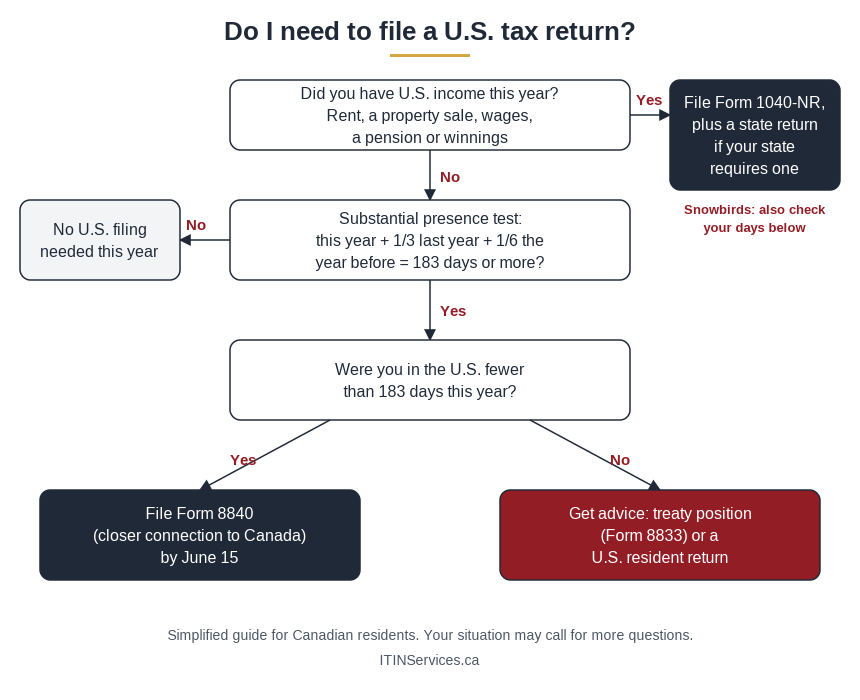
As a Canadian resident, you generally need to file a U.S. return if:
- You rent out a property in the United States
- You received a Form 1042-S showing U.S. tax withheld and want it refunded
- You sold U.S. real estate and tax was withheld at closing
- You worked in the United States or earned U.S. business income
- You want to claim a benefit under the Canada-U.S. tax treaty
Filing is also the only way to get back U.S. tax that was over-withheld. The IRS doesn't refund it automatically.
The full IRS rules on who counts as a nonresident, and what you can claim, are in Publication 519, U.S. Tax Guide for Aliens
What we prepare
- Form 1040-NR, U.S. Nonresident Alien Income Tax Return, with Schedule OI
- Rental income and expenses (Schedule E), including depreciation
- State nonresident returns where required
- Form 8833 for treaty-based positions
- Form 8840 (Closer Connection Exception) for Canadians who spend part of the year in the U.S.
- Prior-year returns that were never filed
We prepare individual returns only. We don't prepare LLC, partnership or corporate returns, or Canadian returns.
Filing your first return with an ITIN
You need an ITIN to file a U.S. return if you don't have a Social Security number. For most first-time filers, the W-7 application is attached to the tax return and both go to the IRS together.
Because we're an IRS Certifying Acceptance Agent, we verify your passport ourselves. You courier it to our Montreal office, we verify it and courier it back the same day. Your passport never goes to the IRS.
ITIN clients get a reduced fee on their tax return.
Already applied for an ITIN on your own?
If the IRS sent you a CP566 or CP567 notice, we can take over the file and resubmit it with the return.
U.S. rental income
If you rent out a condo or house in the U.S., the default rule is a 30% tax on your gross rent, with no deductions. Most Canadian owners are better off electing to be taxed on net rental income instead, after expenses and depreciation.
You make this choice, called the net election under section 871(d) of the Internal Revenue Code, by attaching a statement to your 1040-NR. It covers all your U.S. real estate income and stays in place for later years unless the IRS agrees to revoke it. You don't make it again each year, but you do need to file each year.
To keep those deductions, the return has to be filed on time. The IRS can deny deductions on a nonresident return filed more than 16 months late. Once you make that election, give your property manager Form W-8ECI so they stop withholding 30% on your rent.
Worked example: a Florida condo
Here is a simplified example for a Canadian who owns a condo in Florida and rents it out all year through a property manager. The figures are illustrative, in U.S. dollars, for the 2025 tax year.
| 30% tax on gross rent | Net election | |
|---|---|---|
| Gross rent received | $30,000 | $30,000 |
| Property management (10%) | Not deductible | -$3,000 |
| Condo association (HOA) fees | Not deductible | -$4,800 |
| Property tax | Not deductible | -$4,200 |
| Insurance | Not deductible | -$2,400 |
| Mortgage interest | Not deductible | -$3,600 |
| Repairs and maintenance | Not deductible | -$1,200 |
| Depreciation (building worth $250,000, over 27.5 years) | Not deductible | -$9,091 |
| Taxable amount | $30,000 | $1,709 |
| U.S. federal tax | $9,000 | About $171 |
Under the default rule, the IRS taxes the full $30,000 at 30%: $9,000. With the net election, the taxable amount drops to $1,709. Nonresidents don't get the standard deduction, so that amount is taxed from the first dollar at the 10% bracket: about $171. That's a difference of roughly $8,800 in a single year.
A few things sit behind those numbers. Depreciation applies to the building only, not the land, so the purchase price has to be split between the two. If you also use the condo yourself, expenses are divided between rental days and personal days. If expenses are higher than rent, the loss can generally be carried forward to later years. Depreciation also lowers your cost base, and the IRS taxes it back (recapture) when you sell. Florida has no state income tax, so this owner files only the federal 1040-NR.
Refunds of tax withheld on a Form 1042-S
U.S. payers often withhold 30% on pensions, annuities, prizes, royalties and other payments to Canadians. Under the treaty, much of that tax is often refundable, but only if you file. See our Form 1042-S guide for Canadians
Sold U.S. property?
When a Canadian sells U.S. real estate, the buyer usually withholds 15% of the sale price under FIRPTA. That's a prepayment, not your final tax. Filing a 1040-NR is how you get back the part you don't owe. We prepare the return and the ITIN application you'll need for it. Learn more about FIRPTA refunds
U.S. gambling winnings
Casino and lottery winnings in the U.S. are usually taxed at 30%. Canadians can often recover part or all of it. Our sister service handles these claims: CasinoTaxRefund.ca
Snowbirds: the substantial presence test and Form 8840
You can have a filing obligation even with no U.S. income. If you spend a lot of time in the United States, the substantial presence test can treat you as a U.S. resident for tax purposes, which would mean reporting your worldwide income to the IRS.
The test uses a weighted formula over three years. You meet it if you were in the U.S. at least 31 days this year and this total reaches 183 days:
- All the days you were present this year
- Plus one third of the days you were present last year
- Plus one sixth of the days you were present the year before that
Any part of a day counts as a full day. A snowbird who spends 120 days in Arizona every winter counts 120 + 40 + 20 = 180 days, just under the line. At 130 days a year, the total is 130 + 43 + 22 = 195, and the test is met.
If you meet the test but were in the U.S. fewer than 183 days in the current year, you can usually stay a nonresident by showing a closer connection to Canada on Form 8840. It's due June 15 for the previous year, filed with your 1040-NR or mailed on its own if you have no return to file. If you miss it, the IRS can refuse the exception. If you were in the U.S. 183 days or more in the current year, Form 8840 isn't available, and the tie-breaker rules of the Canada-U.S. treaty, claimed on Form 8833, are the usual route.
Each spouse counts days separately. The U.S. immigration rule that limits Canadian visitors to about six months is a separate question from this tax test.
State returns: which states require one?
The 1040-NR covers federal tax only. Many states also tax nonresidents on income from property located there, and each state has its own form and filing threshold. Here is how the states most popular with Canadians compare for rental income:
| State | State income tax on rent | Nonresident return |
|---|---|---|
| Florida | No | None |
| Texas | No | None |
| Nevada | No | None |
| Washington | No | None |
| Tennessee | No | None |
| Arizona | Yes | Form 140NR |
| California | Yes | Form 540NR |
| New York | Yes | Form IT-203 |
| North Carolina | Yes | Form D-400 with Schedule PN |
| South Carolina | Yes | Form SC1040 with Schedule NR |
| Georgia | Yes | Form 500 with Schedule 3 |
| Hawaii | Yes | Form N-15 |
States without an income tax can still tax rentals in other ways. Florida, for example, charges sales tax and local tourist development tax on rentals of six months or less, which the owner or the booking platform must collect and remit. Thresholds and forms change, so we confirm the rules for your property's state every year.
The Canadian side
As a Canadian resident, you report your worldwide income to the CRA, including U.S. rent. The rental income and expenses go on your Canadian return in Canadian dollars, using Canada's own rules for expenses and capital cost allowance, which differ from the U.S. rules.
To avoid being taxed twice on the same income, you can generally claim a foreign tax credit in Canada for the U.S. income tax you paid on it. That's one more reason the U.S. return matters: the credit is based on your actual U.S. tax, so the U.S. figures need to be final. If the total cost of your foreign property is more than $100,000 CAD, Form T1135 may also be required. A rental property counts; a property used mainly for personal purposes doesn't.
We don't prepare Canadian tax returns. We prepare your U.S. return and give you a copy, so your Canadian accountant has the figures needed for the foreign tax credit.
What happens if you don't file
- Lost deductions: if your 1040-NR is filed more than 16 months after its due date, the IRS can deny your deductions and tax rental income on the gross amount. For a return due June 15, 2026, that limit is October 15, 2027.
- Late filing penalty: generally 5% of the unpaid tax for each month or part of a month the return is late, up to 25%, with a minimum penalty once a return is more than 60 days late.
- Late payment penalty: 0.5% of the unpaid tax per month, up to 25%, plus interest that compounds daily.
- Lost refunds: tax withheld on your income is treated as paid on April 15 after the tax year, and you generally have three years from that date to claim it back. After that, the refund is gone for good.
- No time limit for the IRS: when no return is filed, the usual three-year limit on assessments never starts.
If you're behind, filing the missing years now usually limits the damage. We prepare prior-year returns and tell you which years matter most.
Document checklist
Gather what applies to you. We confirm the exact list with your quote.
- Your passport, or your ITIN or SSN if you already have one
- Last year's U.S. federal and state returns, if any
- Forms 1042-S, 1099, W-2 or other U.S. tax slips
- Rental: statements of gross rent from your property manager or booking platform
- Rental: receipts or statements for condo fees, property tax, insurance, repairs, utilities and management fees
- Rental: Form 1098 or a year-end mortgage interest statement
- Rental: the closing statement from your purchase and records of improvements, to calculate depreciation
- Rental: the number of days the property was rented and the days you used it yourself
- Sale: closing statements for the purchase and the sale, and Form 8288-A showing the FIRPTA tax withheld
- Snowbirds: the dates you entered and left the U.S. over the last three years
- Any letters or notices you received from the IRS
How it works
- Tell us about your situation through the form, or book a call
- We send you a quote and a list of the documents we need.
- You send your documents (and your passport by courier if you need an ITIN).
- We prepare the return and send it to you for review.
- You sign by hand and mail it, or we mail it with your W-7.
Deadlines
- June 15: the usual due date for Canadians with no U.S. wages
- April 15: the due date if you received U.S. wages subject to withholding
- Refunds: you generally have three years from April 15 of the year after the tax was withheld. After that, the refund is lost.
Frequently asked questions
Do I still need to file in Canada?
Yes. Canadian residents report worldwide income on their Canadian return and can generally claim a foreign tax credit for U.S. tax paid. We give you the figures your Canadian accountant needs.
Do I need to come to your office?
No. Everything is done remotely. Your passport travels by courier and comes back the same day.
Can I e-file?
Not the first year with a W-7. Those returns are mailed to the IRS on paper, with the application attached.
How long will my refund take?
Paper returns filed with a W-7 are processed after the ITIN is issued, so expect several months.
I didn't file in past years. Can you help?
Yes. We prepare prior-year returns. The sooner they're filed, the more of your refund and deductions you keep.
Do all states require a return?
No. Florida and Texas have no state income tax. Others, like Arizona and California, generally require a nonresident return for rental income.
Not sure if you need to file? Tell us your situation and we'll tell you what's required.
Start my return